Voith Paper Modernizes Site Documentation with Cutting-Edge Reality Capture

In a world dominated by digital screens and devices, is there still a place for paper?

Absolutely, says Gregor Muhs, Manager for Digital Tools at Voith Paper. 

For over 20 years, Gregor has worked at the German firm responsible for designing, installing, and servicing machines that produce about one-third of the world’s paper, from thin magazine pages to thick cardstock. 

“We believe our end product–paper–makes the world better and more sustainable,” says Gregor. “And we also focus on sustainable processes in-house as well, and suppliers that help us achieve those goals.”

Since the Voith team has to make site visits to inspect and install massive paper machines, the costs–and environmental impact–can add up. So, when the on-site service team asked about more modern solutions to document progress, Gregor and his team were on board.

Pushing the envelope of reality capture

Producing a resource as delicate as paper requires machines that are anything but. Voith’s papermaking machines can be anywhere from 150 to 600 meters long (about 1 to 5 American football fields in length), 12 to 20 meters wide, and 4 stories high.

“The challenge [in capturing progress] is that all our machines are very, very big,” says Gregor. “But although it’s very big, we can be very fast.”

Since it can take between 18-36 months for Voith to deliver a new papermaking machine to a client, capturing the installation statuses throughout the project duration is critical. But prior solutions weren’t cutting it for the Voith Paper team. 

“We were using simple HD cameras and cell phones,” shares Gregor. “But we knew there was the possibility to apply 360-degree cameras, and that was the idea from our site divisions.” 

Gregor and his team began researching on-site progress visualization and monitoring solutions, which led them to Cupix. After piloting Cupix on a rebuild project in France, several factors influenced Voith Paper’s decision to adopt Cupix:

  • Technical Superiority: Gregor cites seamless 360° site visualization, mobile usability, and BIM integration as key factors that influenced his team’s decision. Cupix’s ability to continuously develop and introduce new features, such as voice annotations and measurements, further distinguished it from competitors.
  • Ease of Use: Because the Voith Paper team was used to taking captures on their phones, using the Cupix mobile app was an easy transition. Cupix’s intuitive interface also meant that Voith team members could adopt the platform with minimal training. “It's very easy to record [captures] and navigate the platform,” adds Gregor.
  • Strong Partnership: Voith valued the flexibility and support provided by the Cupix team. From customizing the enterprise agreement to offering responsive customer service, Cupix demonstrated a commitment to building a strong partnership with Voith.

Getting teams on the same page

As Gregor and his team started rolling out Cupix to the on-site service teams, the reaction was even more positive than Gregor thought.

“The reaction was really relieved, like, ‘Wow, finally!’” jokes Gregor. “But even for these teams that don’t go on site, they were really impressed and very happy to have a modern way to see progress in this 360-degree walkaround.”

According to Gregor, Voith Paper averages 1-2 site captures per week during installations, giving them a holistic view of all projects in their portfolio. And as the rollout of Cupix continued, Voith Paper has achieved significant improvements in project efficiency, including:

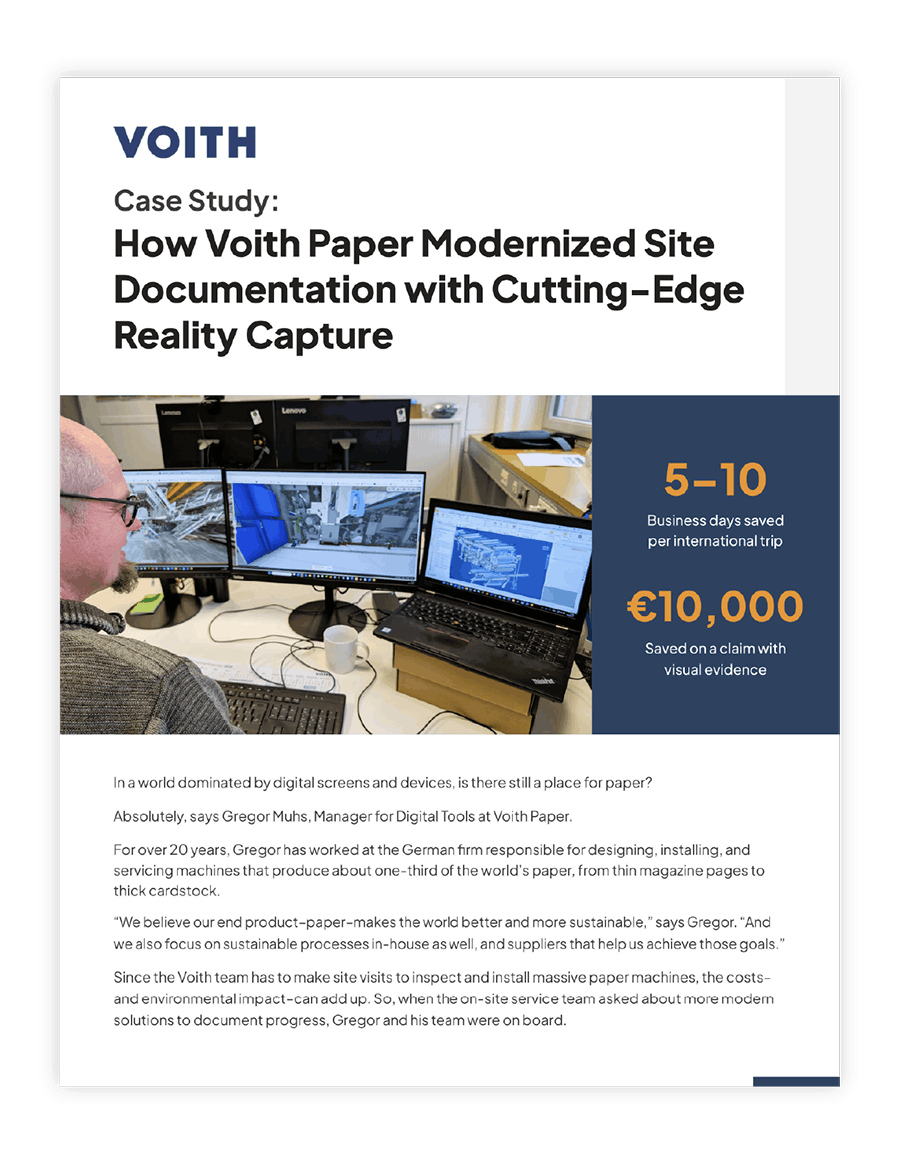
  • Reduced Manpower and Travel Costs During Rebuilds: By using Cupix for site documentation, Voith is now sending one person to capture the jobsite instead of two or three like it did in the past. Voith team members scan the site and figure out what’s needed for a rebuild before it starts, and what parts of the machine might need to be scanned later. On international projects, Gregor estimates using Cupix saves 5-10 business days per trip, resulting in substantial cost savings. 
  • Enhanced Claim Management: Cupix’s 360° documentation has been instrumental in resolving disputes. On a project in Finland, Voith used Cupix to prove that corrosion on a machine was caused by a leaking roof, not their installation. Having visual evidence for just this one claim saved the company €10,000.
  • Remote BIM Collaboration: Team members like Gregor who aren’t on-site can still check on project progress with Cupix. Gregor uses the BIM Compare tool to visually check for design deviations (the model transport feature is a favorite). Teams who join the project months or years later can also see the past, current, and future situations with Timeline Compare.
  • Sustainable Ways of Working: By minimizing the environmental impact of frequent site visits, Cupix has helped Voith align its operations with its broader sustainability goals. “We strive for a carbon footprint that equals zero in some years, and Cupix helps us by reducing travel requirements,” says Gregor.
  • Complementary Use with Other Tools: Voith integrated Cupix with their existing tools, such as 3D laser scans, to enhance their capabilities. While laser scans are used for detailed modeling, Voith team members can capture the entire machine with 360 cameras and get cameras into tight spaces, making the two solutions complementary. 

Writing a new chapter

With hundreds of users actively taking captures with Cupix, Voith Paper has been able to strengthen its service offerings across the world. Even before an installation or upgrade begins, teams can scan the machines to see where they need maintenance today, and where they might need it in the future. 

And ultimately, even though Voith is a papermaking company, adopting digital technology like Cupix has been a boon for their business.

“Cupix is an everybody, everywhere, anytime tool,” says Gregor. “It really brings speed and efficiency to our business…and I see an open road of possible development and technical solutions ahead of us.”

Optimize rebar inspections with CupixWorks' powerful annotation feature. Streamline your process by effortlessly reviewing and submitting checklists using the annotation tool, consolidating and archiving your inspection reports in one convenient location.Effortlessly archive rebar inspections with a streamlined solution. Access visual reference and comprehensive data for easy retrieval and analysis. Experience the convenience of a centralized rebar inspection archive, ensuring efficient organization and enhanced accuracy.Effortlessly archive rebar inspections with a streamlined solution. Access visual reference and comprehensive data for easy retrieval and analysis. Experience the convenience of a centralized rebar inspection archive, ensuring efficient organization and enhanced accuracy.Effortlessly archive rebar inspections with a streamlined solution. Access visual reference and comprehensive data for easy retrieval and analysis. Experience the convenience of a centralized rebar inspection archive, ensuring efficient organization and enhanced accuracy.
Return to News and Info home

Voith Paper Modernizes Site Documentation with Cutting-Edge Reality Capture

Simply fill out the form to download

In a world dominated by digital screens and devices, is there still a place for paper?

Absolutely, says Gregor Muhs, Manager for Digital Tools at Voith Paper. 

For over 20 years, Gregor has worked at the German firm responsible for designing, installing, and servicing machines that produce about one-third of the world’s paper, from thin magazine pages to thick cardstock. 

“We believe our end product–paper–makes the world better and more sustainable,” says Gregor. “And we also focus on sustainable processes in-house as well, and suppliers that help us achieve those goals.”

Since the Voith team has to make site visits to inspect and install massive paper machines, the costs–and environmental impact–can add up. So, when the on-site service team asked about more modern solutions to document progress, Gregor and his team were on board.

Pushing the envelope of reality capture

Producing a resource as delicate as paper requires machines that are anything but. Voith’s papermaking machines can be anywhere from 150 to 600 meters long (about 1 to 5 American football fields in length), 12 to 20 meters wide, and 4 stories high.

“The challenge [in capturing progress] is that all our machines are very, very big,” says Gregor. “But although it’s very big, we can be very fast.”

Since it can take between 18-36 months for Voith to deliver a new papermaking machine to a client, capturing the installation statuses throughout the project duration is critical. But prior solutions weren’t cutting it for the Voith Paper team. 

“We were using simple HD cameras and cell phones,” shares Gregor. “But we knew there was the possibility to apply 360-degree cameras, and that was the idea from our site divisions.” 

Gregor and his team began researching on-site progress visualization and monitoring solutions, which led them to Cupix. After piloting Cupix on a rebuild project in France, several factors influenced Voith Paper’s decision to adopt Cupix:

  • Technical Superiority: Gregor cites seamless 360° site visualization, mobile usability, and BIM integration as key factors that influenced his team’s decision. Cupix’s ability to continuously develop and introduce new features, such as voice annotations and measurements, further distinguished it from competitors.
  • Ease of Use: Because the Voith Paper team was used to taking captures on their phones, using the Cupix mobile app was an easy transition. Cupix’s intuitive interface also meant that Voith team members could adopt the platform with minimal training. “It's very easy to record [captures] and navigate the platform,” adds Gregor.
  • Strong Partnership: Voith valued the flexibility and support provided by the Cupix team. From customizing the enterprise agreement to offering responsive customer service, Cupix demonstrated a commitment to building a strong partnership with Voith.

Getting teams on the same page

As Gregor and his team started rolling out Cupix to the on-site service teams, the reaction was even more positive than Gregor thought.

“The reaction was really relieved, like, ‘Wow, finally!’” jokes Gregor. “But even for these teams that don’t go on site, they were really impressed and very happy to have a modern way to see progress in this 360-degree walkaround.”

According to Gregor, Voith Paper averages 1-2 site captures per week during installations, giving them a holistic view of all projects in their portfolio. And as the rollout of Cupix continued, Voith Paper has achieved significant improvements in project efficiency, including:

  • Reduced Manpower and Travel Costs During Rebuilds: By using Cupix for site documentation, Voith is now sending one person to capture the jobsite instead of two or three like it did in the past. Voith team members scan the site and figure out what’s needed for a rebuild before it starts, and what parts of the machine might need to be scanned later. On international projects, Gregor estimates using Cupix saves 5-10 business days per trip, resulting in substantial cost savings. 

  • Enhanced Claim Management: Cupix’s 360° documentation has been instrumental in resolving disputes. On a project in Finland, Voith used Cupix to prove that corrosion on a machine was caused by a leaking roof, not their installation. Having visual evidence for just this one claim saved the company €10,000.
  • Remote BIM Collaboration: Team members like Gregor who aren’t on-site can still check on project progress with Cupix. Gregor uses the BIM Compare tool to visually check for design deviations (the model transport feature is a favorite). Teams who join the project months or years later can also see the past, current, and future situations with Timeline Compare.
  • Sustainable Ways of Working: By minimizing the environmental impact of frequent site visits, Cupix has helped Voith align its operations with its broader sustainability goals. “We strive for a carbon footprint that equals zero in some years, and Cupix helps us by reducing travel requirements,” says Gregor.
  • Complementary Use with Other Tools: Voith integrated Cupix with their existing tools, such as 3D laser scans, to enhance their capabilities. While laser scans are used for detailed modeling, Voith team members can capture the entire machine with 360 cameras and get cameras into tight spaces, making the two solutions complementary. 

Writing a new chapter

With hundreds of users actively taking captures with Cupix, Voith Paper has been able to strengthen its service offerings across the world. Even before an installation or upgrade begins, teams can scan the machines to see where they need maintenance today, and where they might need it in the future. 

And ultimately, even though Voith is a papermaking company, adopting digital technology like Cupix has been a boon for their business.

“Cupix is an everybody, everywhere, anytime tool,” says Gregor. “It really brings speed and efficiency to our business…and I see an open road of possible development and technical solutions ahead of us.”

Return to News and Info home

Voith Paper Modernizes Site Documentation with Cutting-Edge Reality Capture

See what Cupix can do for you.