%401x.png)


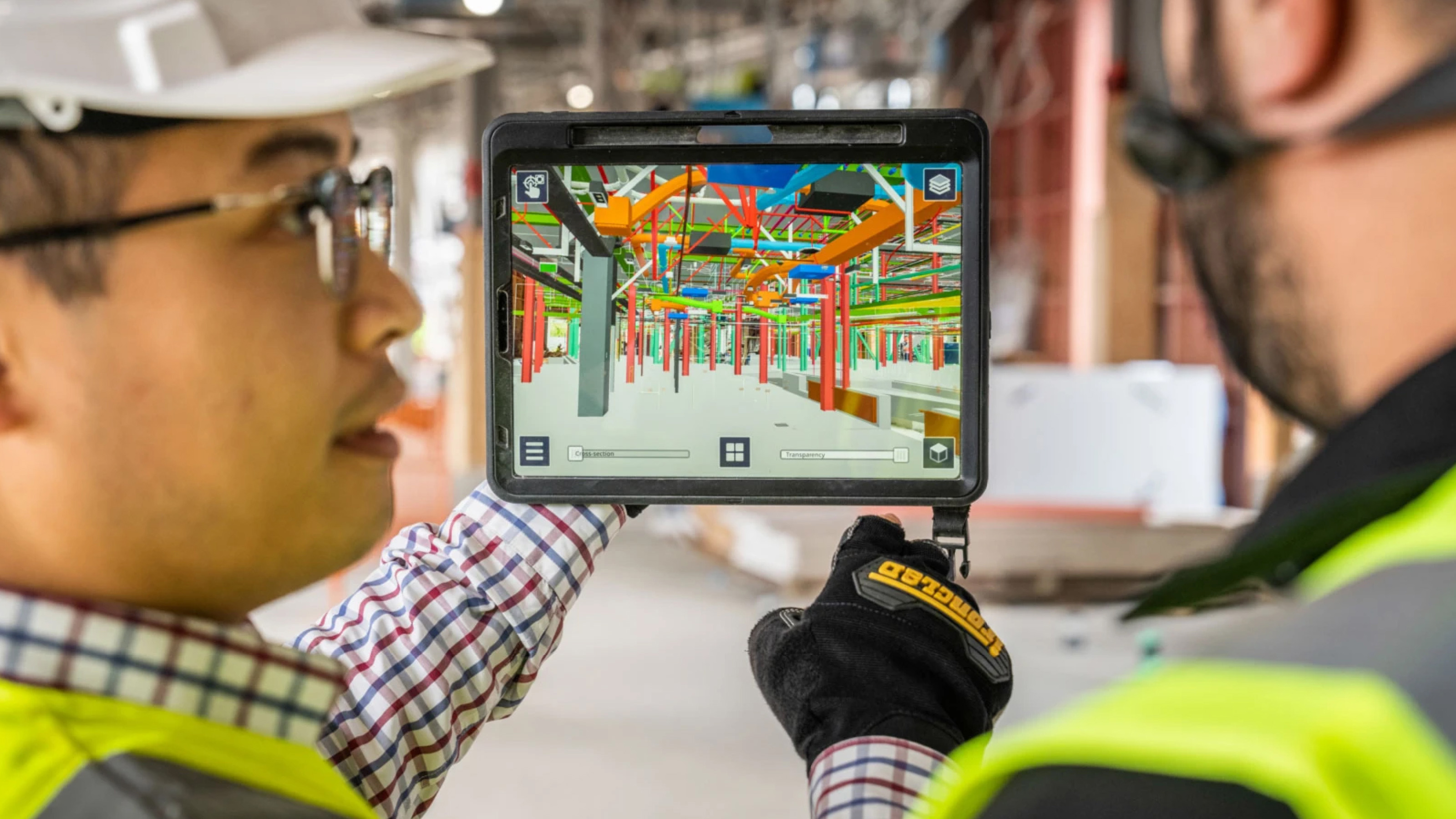
The backbone of a construction project used to be the drawing set. The plans on the wall, the binders in the site office and the as-built mark-ups handed over at completion were the connective tissue that held a job together. That model is breaking down. Projects are bigger, programs tighter, supply chains more complex, and the gap between what was designed and what is being built is harder to see and more expensive to close.
A new generation of digital-first contractors is rebuilding that backbone around something different. Spatial Intelligence. A connected, time-stamped, geo-tagged record of site reality that sits alongside the model and lets every team work from the same source of truth. The contractors leading the shift are making it the standard the rest of the supply chain has to meet.
Southbase, the New Zealand-headquartered builder behind a growing portfolio of healthcare, commercial and complex public projects, is among the clearest examples of what that shift looks like in practice. The firm has built prefabrication, sustainability and digital engineering into a single operating model, and treats Spatial Intelligence as core infrastructure rather than an optional extra.
Jonathon Dutton, Southbase's Digital Lead, frames the case in plain terms. “The biggest risk in our industry is uncoordinated designs and bad documentation,” he says. “They lead on to on-site incidents and rework. The use of technology in the design and build stage alleviates that.” Southbase predominantly operates under a design-build and managing contractor model, which puts the firm in the room for the decisions that drive the bulk of cost and time outcomes.
Building the digital backbone
Southbase did not start with a single platform. It started with a problem statement: communication between consultants, contractors and trades was the largest source of buildability failure on site, and the firm needed connected tools to close that gap.
A leading BIM coordination platform became the first piece of the stack. “It effectively grabbed all the information produced, all the designs produced by consultants, all those BIM models and drawings, and brought them all into one place,” Dutton says. The Autodesk Construction Cloud, Revit and the broader Autodesk suite layered on top, giving designers, coordinators and on-site teams a connected environment to work in.
Reality capture followed. Southbase trialed several aerial and interior platforms, starting with aerial drone capture for site imagery. After evaluating the leading interior options, Cupix was selected for the firm's largest live project, the new Dunedin Hospital Outpatients Building, where it has now been running as a proof of concept for three years.
In a sector where digital adoption is often measured in pilots that never scale, Southbase's approach has been the opposite. The digital team operates on every project. Subcontractors are vetted on their digital readiness before they are hired. “We have a digital-first mentality,” Dutton says. “If our subcontractors aren't on board, then they can't be hired.” That is a procurement filter, not a soft preference.
Aligning intent and reality on the Dunedin Hospital

The clearest demonstration of what Spatial Intelligence does for a delivery team played out on the Dunedin Hospital project. Mid-construction, the architect issued a design change to the medical service panels, the wall-mounted units behind every hospital bed that carry medical gas, electrical and pipework into a single integrated assembly.
Design changes mid-build can throw a program into disarray. They typically generate hours of site walks as digital teams try to work out what has already been installed. None of Dutton's digital modelling team were based on site. In a previous era, that would have meant a logistical scramble.
Instead, the team worked the problem entirely in the digital environment. Using Cupix in combination with the project's BIM coordination environment, they identified every location where the design change touched the building, then cross-referenced those locations against the most recent Cupix capture to see what had actually been built. The findings were precise. Eighty percent of the affected locations had not yet had steel installed behind the wall, so no rectification was needed. The remaining 20 percent required on-site changes, communicated directly to site teams and the fabricator with spatial imagery and exact locations attached.
“If we hadn't had Cupix for that, the process would have been a lot harder,” Dutton says. “I'd have to go to site, or use one of my guys on site to walk around. Whereas now we'd already identified them and we can click to them just like a click of a button. The time saved is huge.”
The entire issue was resolved off-site by the people who needed to make the design and fabrication changes. Design intent and site reality, sitting in the same view, available to the people closest to the decision.
Detecting risk before it spirals
Buildability is one half of digital coordination. Catching errors in the digital fabric itself is the other. Dutton describes a recent incident where a sudden cluster of clashes appeared in the federated model, with cross-bracing apparently colliding with ductwork across the project.
His instinct, sharpened by two decades in digital engineering, was to ask why the clashes had appeared all at once. Investigation revealed that a consultant had linked an outdated model into the federation. Southbase's audit processes flagged it within minutes.
Dutton is careful not to overclaim what the technology did. “The knowledge of the people that you're working with is incredibly important. I've worked with people in the past that just flag a whole heap of problems, but they might not understand what they actually mean.” The technology surfaced the anomaly. The experienced practitioner understood what it meant. The argument is rarely about replacing senior practitioners with digital natives. It is about giving experienced people better tools so their judgment scales further. “Knowledge sharing has always come down from senior to junior,” Dutton says. “With the use of technology, it goes both ways.”
Bringing the supply chain on the journey
The Hilti Jaibot story captures Southbase's broader philosophy on the supply chain. The robotic drilling unit, a New Zealand construction first on the Dunedin project, drilled thousands of overhead anchor points for seismic frames. It was driven directly off the federated digital model that Dutton's team had coordinated with subcontractors. Off-site, prefabrication of the seismic steel was happening to the same model. When the steel arrived on site, it was lifted into place and fitted first time.
The subcontractor running the drilling, had not previously used a digital coordination platform of this kind. He learned it on the project and helped deliver a national first before retiring at the end of the build. “In our mind, it's improving the whole industry,” Dutton says.
Protecting the asset across its lifecycle

For the client, the value of the digital backbone shows up most clearly at handover. Traditional handover means stacks of as-built drawings that get filed away and only revisited when something fails. Southbase now hands over the model, the visual as-built data set, and an offline Cupix viewer that lets facilities teams walk the building virtually long after the construction crew has left.
Dutton sees Cupix becoming the as-built deliverable in its own right. The platform already captures the information needed to identify whether services have been installed within the relevant tolerance, and as the photogrammetry and point cloud capabilities mature, the case for relying on Spatial Intelligence as the primary as-built record gets stronger. “Gone will be the days of having to look at drawings for as-built,” he says. “You can just open Cupix. The information you actually need is there.”
Dutton frames transparency as both a relationship and a physical capability. “It's actual physical transparency, because they can literally look through a wall. They can see what's behind that wall, they can see when it was built.” For an asset owner planning a refit five years out, that is the difference between a confident scope and a dig-and-discover exercise. It is also the difference between a record that protects the team if a question is raised, and a paper trail that does not.
The new backbone is already being built
Southbase's experience makes a quiet but important point. The shift from drawing-led to data-led project delivery is not a future-state conversation. It is happening on live jobs across the region. Spatial Intelligence is becoming the connective tissue that holds a project together from concept through to operations, and the contractors investing in it now are setting the standards their supply chains will inherit.
For project leaders, BIM managers and asset owners, the question is no longer whether reality capture earns its place. It is whether the rest of the digital stack is connected enough to turn that data into a shared source of truth. The contractors that get this right are building the new backbone of how complex projects get delivered.