%401x.png)


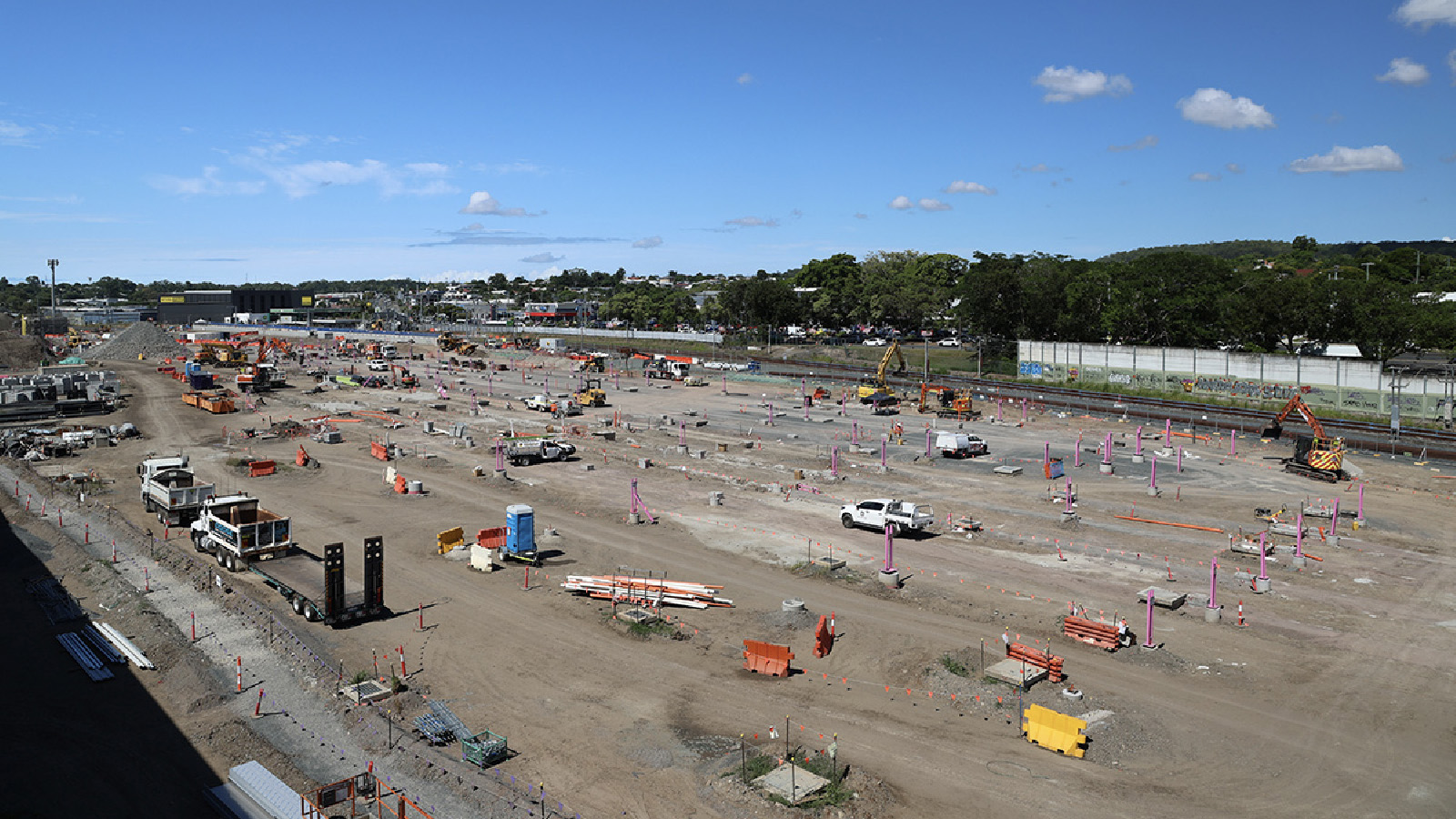
Brisbane’s Cross River Rail Project is one of the most ambitious infrastructure projects undertaken in the state, with worksites above and below ground, trackwork, tunnels, and stations all being coordinated across a multi-year program.
Not only are the spatial dimensions of the project complex, the engineering and construction process have been utilising digital design and project management to optimise for efficiency and quality across project deliverables.
“The Delivery Authority took a digital first approach a step further, embedding this into our project’s DNA from early concept design throughout the delivery process,” says Jordan Haimes, Director, Specialised Services and Solutions, Corporate, Cross-River Rail Authority Delivery Authority.
Managing project risk
One of the more intense engineering feats was the design and construction of 5,9 kilometres of underground rail tunnels under the Brisbane CBD. This required detailed risk mitigation plans to address factors including geotechnical conditions, design detail, coordination through a heavily constrained brownfield environment, and the concerns of stakeholders. These stakeholders include the second largest hospital in Queensland, a private school located at Northern tunnel entrance, and the general business community needing to carry on as usual aboveground along the route.
Managing the unique combination of technical risks, operational risks and the financial risks associated with such demanding project required the Cross River Rail Delivery Authority (CRRDA) to ensure exceptional coordination and communication through the project lifecycle.
The use of digital project management, verification and compliance assurance processes is key throughout delivery. Design, delivery, and commissioning were synchronised through the use of interoperable software and digital-first approaches.
This way of thinking was embedded early in the project planning stages, to streamline the process of onboarding the many specific consultants, subcontractors and delivery partners into the live project digital architecture.
Real-time delivery optimisation
Change is a constant in construction, and one of the key advantages for CRRDA in their digital approach was it is agile, able to respond and adapt as new challenges arose. Regular meetings were held between the digital engineering team and the program directors responsible for specific packages such as individual stations, sections of track, operational rail systems or tunnel sections.
These meetings enabled the digital engineering team to respond to any pain points or issues that emerged.
An example, when mechanical and electrical fitout works commenced, tracking and ensuring information on progress was accurate across the installation team, engineering teams and project managers required a solution that did not rely on subjective interpretation.
Tracking completion through a ‘virtual site diary’ using reality capture was trialled, as a way to ensure activity on-site could be checked and coordinated against design schematics, project program documentation, site drawings, specifications and any other relevant documentation such as inspection and testing plans and certifications.
By leaning into direct capture with digital the team were able to improve record-keeping, reducing human error. The visual and spatial evidence, clearly tagged with time and date, becomes an easy to access transparent source of truth that can be integrated seamlessly with project documentation and progress tracking.
Cupix was a key software in the wider technology stack, as an asset in ensuring the reality capture integration, with the additional benefits of efficient AI-enabled coordination with design specifications, BIM models and project plans. The tool was made available across the delivery team, including subcontractors, and the project sponsors.
In addition to the works verification aspect, having the reality capture process embedded in the delivery phase has provided a project governance dividend.
It supports more efficient reporting, enhances visibility of progress and boosts the evidence available in the event of future claims or other issues during the operation and maintenance phases. Spatial intelligence and the digital record shows clearly what was done, where and by whom and verifies quality and compliance with relevant codes, standards and contractual obligations.
“We consume visual information magnitudes of order faster than we can text-based information, by showcasing ideas and issues, we ensure all stakeholders are aligned and understand complex issues quickly.” Haimes explains.
A lifecycle view
Beyond construction, by including the digital evidence and reality capture within the project BIM models and digital documentation, the detail of the project moving into the operational phase is comprehensive.
This will result in lifecycle benefits for maintenance, operations, and ongoing asset management. Having detailed data on the equipment, materials and system elements right down to individual controls, sensors, bolts, fans and cables will improve the performance of the asset for both cost savings and enhanced capabilities to manage the assets into the future.
Another example, if there is a need to undertake maintenance or replacement of a part, the model can be used to plan out the maintenance activity, including visualising where the part is, and what the most efficient and safe access route is to reach it.
There are also benefits for the model when planning for major events, including the future Brisbane 2032 Olympic and Paralympic Games.
Earlier than ever before, the project can provide assurance that the expected crowds can move smoothly through the various public transport systems, with the opportunity to explore various options that can support crowd control, security, and emergency services personnel with familiarising themselves with the layout and other crucial information.
“Being able to build confidence and assure the invested project partners and sponsors of outcomes has been a key differentiator with more traditional approaches to delivery,” says Haimes.
Stakeholders onboard
This capability was also used throughout the delivery phase to optimise aspects of the final design and construction.
Stakeholder engagement, as an example, utilised digital models early on in the project to refine decisions including accessibility for people using wheelchairs. Through involving the Accessibility Reference Group in a session that utilised a 270-degree projection room to immerse the users at scale and demonstrate movement through stations, the DA has been able to explore multiple improvements for station accessibility.
Digital modelling also enabled the delivery team to work with a representative group of Train Drivers to provide early assurance and confidence in the design of signals, also exploring options for various solutions in a cost and time efficient manner. While the project has embedded a state-of-the-art train control system, for safety and resilience, an additional analogue backup system of signals and track controls is also incorporated. The drivers were able to provide valuable feedback on the best location for the analogue signals in the context of the tunnel environment, train speeds and the drivers’ field of vision.
The advantage of doing the detailed design refinement in the models is it offers a lower-cost pathway to optimising for real-world operational conditions, compared to testing a built prototype or engaging in rework of a completed project package.
The project digital engineering allows for optioneering with stakeholders and key user groups, with the capability to present multiple solutions, all of which have been pre-tested for fit with the broader model and project systems.
Subject matter experts can also be brought onboard to contribute advice and insight, resulting in outcomes that are both buildable and stakeholder approved.
This represents a clear benefit in time, costs, quality, and project excellence.
Insights drive success
Ultimately, successfully achieving a project as complex and rigorous as Cross River Rail means managing complex, challenging and time-sensitive communication effectively.
This is where using digital delivery, including detailed, integrated and spatial BIM models delivers a huge return on investment. Having the capability to retrieve visual evidence in the form of photos and documentation of a specific project milestones or element results in Executives, leadership teams and other decision-makers being able to provide accurate insight and real-time intelligence on project progress. In addition, there is a significant time saving in terms of reduced reliance on site visits for project updates, instead, the relevant parties can access project insights instantly, and from any secure, connected device.
This also holds true into the operational phase, with asset managers and others having access to detailed, comprehensive insight that can support the development of proactive and preventative maintenance and repair strategies.